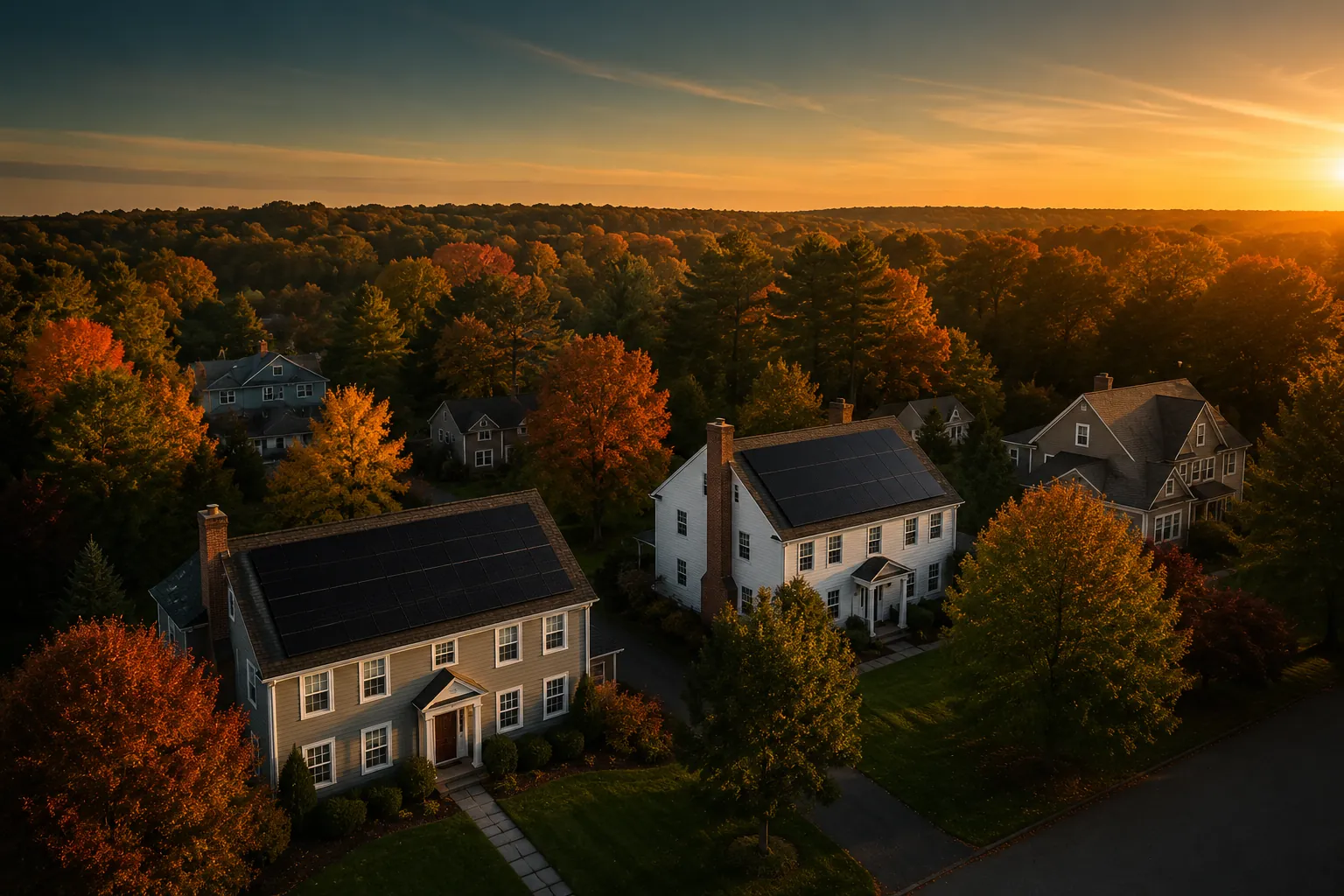
Solar Installation in Framingham: 2026 Quote Guide
Compare Framingham solar installers using Eversource interconnection, SMART 3.0, City permits, roof evidence, local reviews, taxes, and complete quote terms.
Dan Katzman
Founder, Teamsun
The right solar installer for a Framingham home must connect one address, one roof, and one electric account to several different systems: Eversource distribution, the electricity supplier shown on the bill, SMART 3.0, net metering, Eversource interconnection, Framingham permits, and the contract. Compare at least three written proposals using the same inputs. A low monthly payment or a large savings number is not a substitute for that evidence.
Teamsun sells and installs residential solar, so we have a commercial interest if you request a quote. We have not used unverified Framingham project counts, local crews, prices, permit times, customer results, licenses, or reviews in this guide. Require Teamsun and every competing bidder to prove those claims before you choose.
The short version: Start with a current Eversource bill and 12 months of usage. Screen the address in Framingham’s MapGeo system, Eversource’s hosting-capacity map, the local historic district map, and the City’s wetlands map. Then compare gross price, design, roof work, current incentives, interconnection, permits, warranties, and service as separate rows. Do not let a 2026 proposal assume the former 30% federal homeowner credit.
Teamsun’s residential solar installation service explains the broader installation scope. This guide has a narrower job: helping a Framingham homeowner determine whether a quote is complete for the property before signing it.
What makes a Framingham solar installation quote complete?
A complete Framingham quote shows how the proposed system moves through seven gates. Each gate needs address-specific evidence. A generic satellite layout can start a conversation, but it cannot prove that the roof is structurally suitable, the equipment can interconnect, or the City will approve the submitted design.
| Framingham project gate | Evidence to request | Purchase decision it affects |
|---|---|---|
| Electric account | Current Eversource bill, supplier, rate class, meter, and usage history | Baseline bill, eligible account, and savings model |
| Grid location | Dated Eversource hosting-capacity screen and planned application path | Technical review, possible study, and upgrade risk |
| Property | Framingham MapGeo parcel, zoning, ownership, unit count, historic and wetlands screens | Who can authorize work and which local reviews may apply |
| Roof and structure | Site inspection, shade analysis, roof condition, attachment plan, and structural calculations | Array size, reroofing, reinforcement, and production |
| Municipal approval | Current OpenGov building and electrical permit plan, plus any HDC or Conservation approval | Filing responsibility, correction risk, and construction start |
| Program treatment | Separate SMART 3.0, net-metering, tax, and supplier assumptions | Auditable economics without double counting |
| Contract and service | Gross cash price, equipment, exclusions, warranties, milestone payments, and service owner | Total risk, lifecycle cost, and recourse |
Framingham’s official guide to going solar recommends reviewing energy use, evaluating the property, seeking multiple written bids, understanding the contract, securing building and electrical permits, completing inspections, and working with Eversource on interconnection. That sequence remains a sound framework. Current program and permit details still need current sources.
Use this buying order:
- Verify the account, address, ownership, and annual usage.
- Inspect the roof, electrical service, shade, and equipment route.
- Screen local and utility constraints before fixing the final system size.
- Normalize every quote to gross cash price and the same scope.
- Model SMART, exports, taxes, financing, and rate changes separately.
- Verify the contracting entity, licenses, insurance, warranties, and service process.
- Sign only when the contract assigns unresolved work and correction costs.
Our Massachusetts solar installer guide owns statewide provider and credential comparison. This page owns the Framingham address-to-quote decision: the local supplier-versus-utility distinction, current City intake, historic and wetlands screens, roof evidence, and a Framingham-specific proposal checklist.
Is Eversource the electric utility in Framingham?
Yes. Eversource is the distribution utility for Framingham, even if Framingham Community Electricity or another company supplies the electricity. Eversource continues to deliver power, bill the account, and handle solar interconnection. The supplier shown on the bill affects the supply charge; it does not replace the utility.
The City’s Framingham Community Electricity page says the municipal aggregation launched in March 2025. It offers three supply choices under a two-year supply agreement, while Eversource continues as the electric utility and integrates the supply charge into the Eversource bill. A private supply contract or a hold on the account can affect enrollment.
That distinction matters because a salesperson may use the wrong number when estimating savings. A supply price is only one part of an electric bill. Delivery charges, fixed charges, import and export treatment, SMART payments, and future tariff changes must be modeled under their own rules.
Give all bidders identical account information:
- every page of a recent Eversource bill;
- at least 12 consecutive months of kWh usage, and longer history if available;
- the service address, meter number, account number, and rate class;
- the supplier and supply option printed on the bill;
- each meter expected to benefit from the project;
- any existing solar, battery, generator, or service equipment; and
- expected future loads such as an EV, heat pump, addition, accessory unit, or major efficiency work.
Ask each bidder to fill in this bill table:
| Bill input | Evidence | Bidder assumption |
|---|---|---|
| Distribution utility | Eversource bill | |
| Electricity supplier | Supplier line on current bill | |
| Rate class | Tariff or rate identifier | |
| Annual imports | Meter history, not one month’s usage | |
| Fixed and minimum charges | Current bill and tariff | |
| Export value | Current net-metering or other approved credit path | |
| SMART payment | Current qualification, rate, term, and recipient | |
| Rate escalation | Named assumption plus a zero-escalation case |
Framingham Community Electricity is not a solar rebate, net-metering program, or interconnection approval. SMART is a production incentive. Net metering is a bill-credit mechanism. Eversource interconnection is the technical and contractual permission to connect. The proposal becomes easier to audit when those four labels never share one unlabeled “incentives” line.
The City’s program language describes stable supply pricing during the contracted period, but no municipal aggregation can establish a 20- or 25-year solar savings outcome. Compare the current account accurately, then test future savings under several rate scenarios. A quote should still work as a decision document if the supplier changes.
Teamsun crews reach Framingham from the same dispatch area that covers Newton and Worcester, so the permitting, utility, and inspection routine described here is the one our field team already runs locally.
How should Eversource interconnection shape the design?
Interconnection should begin as an address screen, not as an approval promise. Eversource’s hosting-capacity map can identify likely grid constraints and frame the application, but it does not authorize construction or operation. The final system must follow the current Massachusetts interconnection tariff and receive the required utility documents.
Eversource provides a Massachusetts hosting-capacity map. Its hosting-capacity FAQ explains that the map estimates the distributed-energy capacity a location may accommodate under existing conditions. The actual application can still require technical review, changes, studies, or upgrades.
Request a dated record for these questions:
| Interconnection question | Evidence to request | What the evidence cannot prove |
|---|---|---|
| Which circuit or grid location serves the address? | Eversource map result or project record | Final eligibility or available capacity |
| What hosting capacity is displayed? | Dated screenshot or export with location context | Approval or guaranteed upgrade cost |
| Which review route is expected? | Current tariff/process basis using AC size and technology | That Eversource will accept an incomplete application |
| Are studies or upgrades assumed? | Written inclusion, exclusion, or allowance | Final utility condition before review |
| Who submits and responds? | Named applicant and technical contact | A guaranteed completion date |
Massachusetts utility interconnection guidance says a generating-facility owner needs an Interconnection Service Agreement and Authorization to Connect before operating in parallel with the electric grid. The Department of Public Utilities publishes the current utility documents through its interconnection filings and tariffs page. A Framingham building permit, electrical inspection, installed meter, or completed array does not replace Eversource authorization.
Assign every step in the contract:
- preliminary hosting-capacity and service screen;
- collection of account and equipment data;
- interconnection application and any disclosed fee;
- responses to utility corrections or technical questions;
- review of any study or upgrade condition before the homeowner becomes bound;
- execution of the Interconnection Service Agreement;
- City permits, construction, and inspections;
- required meter, protection, or witness work; and
- delivery of Authorization to Connect and all closeout records.
A credible installer can explain its process without guaranteeing what Eversource will decide. Require a contract change process if the utility requires different inverter settings, smaller AC capacity, export controls, additional protection, a study, or construction work. The contract should state who may cancel, who owns design revisions, and whether deposits are refundable under defined utility outcomes.
Do not compare two quotes only by DC panel size. Interconnection decisions often depend on AC inverter capacity, control settings, storage configuration, and export behavior. Require both DC module nameplate and AC inverter nameplate. If a bidder proposes power control or non-export operation, ask for the equipment, control logic, utility approval path, monitoring, failure behavior, and owner limitations in writing.
How do SMART 3.0 and net metering work in a 2026 Framingham quote?
SMART 3.0 and net metering should appear as separate benefits. SMART pays qualifying solar production under a program tariff. Net metering creates bill credits for eligible electricity sent to the grid. A project may use both when it meets the rules, but qualification for one does not approve the other.
As of August 10, 2026, the Massachusetts Department of Energy Resources publishes these Program Year 2026 SMART 3.0 values for qualifying small systems:
| SMART 3.0 category | Published 2026 flat rate | Conditions to verify |
|---|---|---|
| Small tariff generation unit at or below 25 kW AC | $0.03 per metered kWh | Qualification, capacity, metering, current tariff, and program rules |
| Qualifying low-income small unit at or below 25 kW AC | $0.06 per metered kWh | Low-income qualification plus all program conditions |
DOER’s SMART 3.0 program details state that Program Year 2026 includes 600 MW AC of capacity for small units subject to the capacity cap. DOER also reports that DPU approved the revised program tariff on May 19, 2026 and company-specific tariffs on July 8, 2026. Those are current program facts, not an automatic award for every Framingham project.
Require the quote to state:
- DC module capacity and AC inverter capacity;
- claimed SMART category and source date;
- applicant and payment recipient;
- application or qualification status;
- production-metering and reporting equipment;
- modeled annual production and degradation;
- incentive rate and term used in the cash flow;
- renewable-energy-certificate treatment; and
- contract treatment if the project receives a different rate or does not qualify.
Net metering needs its own bill-credit model
The Massachusetts net-metering guide, updated July 13, 2026, explains that credits appear as dollar amounts and depend on the utility, rate class, facility design, ownership, cap status, and other facts. The guide also says a facility cannot generate alternative on-bill credits and net-metering credits at the same time. Check the current net-metering eligibility rules for the proposed ownership and account structure.
A Framingham proposal should show these quantities separately:
| Quantity | Required quote disclosure |
|---|---|
| On-site production used when generated | Load-shape assumption for the benefiting meter |
| Grid imports | Applicable Eversource rate components and fixed charges |
| Grid exports | Current credit formula and tariff source |
| Credit recipient | Exact account or accounts and authority to allocate |
| SMART generation | Metered kWh, category, rate, term, and recipient |
| Supply price | Current FCE, Basic Service, or competitive supplier input |
| Annual production | Weather data, roof plane, shade, losses, and degradation |
| Sensitivity | Lower production and zero retail-rate escalation cases |
“100% annual offset” does not mean a $0 bill every month. Production and consumption occur at different times. Fixed charges can remain. Exported kWh may be valued differently from avoided imports. The supplier and delivery portions of the bill can change on different schedules.
For a two-family, three-family, condominium, or property with multiple meters, never add all annual usage and assume one array can credit every account. Identify roof ownership, project owner, host customer, each meter, and the proposed credit path. State single-parcel and allocation assumptions. An installer may need utility or legal confirmation rather than offering an oral answer.
Apply the programs correctly
Confirm eligibility before an incentive is priced into a quote.
Teamsun verifies program status, capacity limits, and filing deadlines for your service address rather than assuming a statewide figure applies.
Which Framingham permits and local reviews can solar require?
Framingham requires building and electrical permits for solar. The current intake is online through OpenGov. The City’s older solar checklist remains useful for understanding design documents, but its old submission, payment, fee, and timing instructions should not be treated as current.
The Framingham Inspectional Services page says the City moved permitting and licensing to OpenGov on July 1, 2025. It currently lists building applications, a residential short form, and an electrical permit in that portal. The City’s solar guide says an installer must secure building and electrical permits before construction and complete building and electrical inspections.
Framingham’s solar permitting checklist is dated July 26, 2022. It says one- and two-family rooftop projects should include building and electrical materials such as:
- workers’ compensation and debris-disposal affidavits;
- contractor, Home Improvement Contractor, and Construction Supervisor documentation when applicable;
- a site or building plan and equipment layout;
- structural review signed by a Massachusetts-certified engineer, with calculations for PV and snow loads;
- an electrical application and one-line or three-line diagram;
- disconnect, overcurrent, panel, racking, and inverter information; and
- required rough and final inspections.
The checklist routes three-family-and-larger and commercial projects through a more extensive document list. It also contains legacy instructions for copies, delivery, payment, fees, and typical review or inspection timing. Because the City now uses OpenGov, require the bidder to confirm the current form, documents, fees, payment method, signatures, and inspection sequence inside the portal or with Inspectional Services. Do not budget or schedule a 2026 job using the checklist’s 2022 administrative details.
Check zoning by address
Framingham directs owners to its MapGeo property viewer to identify the parcel and zoning. A common flush-mounted rooftop design may have a straightforward path, but the installer still must show that the submitted layout complies. A ground-mounted array, accessory structure, unusual height, nonconforming property, large project, or equipment location can change review.
The current Framingham zoning ordinance includes a dedicated framework for commercial ground-mounted systems of at least 250 kW DC. That framework is not a rule for an ordinary residential rooftop system, and it should not be used to claim that every smaller ground mount is automatically allowed or prohibited. The 2022 solar checklist says to confirm zoning district, setbacks, height, and any variance or special-permit condition for the actual project. Ask Inspectional Services for a written interpretation if the design is not a conventional rooftop array.
Local historic districts can add design review
Framingham’s Historic District Commission oversees exterior changes to designated buildings in local historic districts when the work is visible from a public way. The City says those changes require an HDC application and an approved Certificate of Appropriateness before work begins. The current HDC application says a certificate is required before obtaining a building permit or starting affected exterior construction.
Do not treat every old house as a local historic-district property. Do not assume that a listing on one historic inventory creates the same process as a local district designation. Screen the exact address, visibility, equipment, conduits, meters, roof work, and requested certificate with City preservation staff.
The quote should assign responsibility for:
- confirming whether the parcel or building is designated;
- documenting module, racking, conduit, meter, disconnect, and equipment visibility;
- preparing elevations, product sheets, photographs, and application materials;
- responding to HDC questions and redesign requests; and
- changing or cancelling the contract if approval materially reduces the array.
The HDC says it meets monthly and that agendas close several weeks before meetings. Use that fact to identify a possible schedule dependency, not to promise a one-meeting approval.
Wetlands jurisdiction may affect ground work
Framingham’s Conservation Commission page says more than half the City’s land is within local or state wetlands jurisdiction. That does not mean more than half of homes require a solar filing. It means an address-level screen matters when the scope includes trenching, a ground mount, vegetation removal, grading, access work, or equipment near regulated areas.
The City’s conservation permitting page says most single-family activities within 125 feet of a wetland or 200 feet of a perennial stream require either a Request for Determination of Applicability or a Notice of Intent. Its wetland resource map is a screening tool. Ask the Conservation Office to confirm jurisdiction and filing route; an online map does not replace a field determination.
Require every quote to identify trenching, tree work, staging, access, erosion controls, and ground disturbance. A rooftop array can still create ground work between the building, service equipment, meter, battery, or utility point. “Panels are on the roof” is not evidence that wetlands review is irrelevant.
What roof and electrical evidence should a Framingham homeowner request?
Request a roof-condition plan, structural calculations, and an electrical one-line before treating the system size as final. Framingham’s checklist expressly calls for Massachusetts engineer review with PV and snow-load calculations. That makes a remote roof-area estimate only a preliminary design.
Use this roof schedule:
| Roof issue | Evidence to request | Effect on the purchase |
|---|---|---|
| Covering age and condition | Records, site photos, inspection findings, and roofer scope | Install now, repair, replace, or defer |
| Structure | Signed calculations and permit design basis | Reinforcement, array size, and attachment plan |
| Shade | Annual analysis by roof plane with obstruction assumptions | Production, module placement, and economics |
| Attachments and flashing | Named racking, attachment spacing, waterproofing method, and warranty terms | Leak risk and responsibility |
| Snow and drainage | Layout around drainage paths, roof edges, entries, and pedestrian areas | Safety, usable area, and equipment position |
| Fire and service access | Permit-ready setbacks and pathways | Reduces gross roof area to usable area |
| Future reroofing | Removal/reinstallation price and warranty procedure | Lifecycle cost |
| Ownership | Deed, condominium or co-owner authority, and roof rights | Authority to install and maintain |
If the roof may need replacement during the system’s expected service life, compare two complete scenarios: roof work before solar, or solar now plus future removal and reinstallation. Do not compare only today’s solar contract. Our solar and roofing company guide shows how to allocate design, flashing, workmanship, leak response, and warranty responsibility across contractors.
The electrical scope needs the same detail. Ask for:
- existing service and main-panel rating;
- service, meter, and panel photographs;
- load-side or supply-side connection design;
- exact inverter AC rating and breaker or tap details;
- disconnect, rapid-shutdown, labeling, and grounding plan;
- conduit route and exterior appearance;
- any service, meter, transformer, or panel upgrade assumption;
- battery location and listed equipment when storage is included; and
- who pays for code, utility, or inspector-required corrections.
An installer should not diagnose hidden electrical conditions from a satellite image. The proposal can carry a clearly defined allowance or pre-contract electrical survey, but it should not hide exclusions behind “standard installation.” Make the bidder list what “standard” includes.
One- and two-family homes should be distinguished from three-family, condominium, rental, and mixed-use buildings. Multiple owners or meters can change authority, crediting, permit documents, insurance, and service access. A salesperson is not a substitute for legal advice about condominium rights or for Inspectional Services guidance about building classification.
How should you compare Framingham solar prices and financing?
Compare gross cash price before incentives and before loan payments. Then normalize the scope. Online Framingham price pages cannot see the roof structure, electrical service, shade, historic status, wetlands ground work, Eversource conditions, equipment route, or financing fee at one address.
Have every bidder complete this table:
| Quote field | Bidder A | Bidder B | Bidder C |
|---|---|---|---|
| Gross cash price before incentives | |||
| DC module capacity | |||
| AC inverter capacity | |||
| Gross cash dollars per DC watt | |||
| Modules, inverters, racking, and monitoring | |||
| Site survey and shade analysis | |||
| Structural engineering | |||
| Roof work and exclusions | |||
| Electrical upgrades and exclusions | |||
| Framingham building and electrical permits | |||
| HDC, zoning, wetlands, or other review | |||
| Eversource application, studies, and upgrades | |||
| SMART category, rate, term, and recipient | |||
| Net-metering and supplier assumptions | |||
| State tax assumptions | |||
| Financing principal after all fees | |||
| APR, term, payment changes, and prepayment | |||
| Workmanship, roof, equipment, and service terms |
Gross cash dollars per DC watt can expose a broad difference, but it cannot choose the winner. A quote with structural work, a panel upgrade, permit handling, and stronger service may cost more than a bare equipment quote. Conversely, a high price is not justified merely because a salesperson calls the equipment “premium.” Compare named scope and contract obligations.
For financing, require both the cash contract and the financing disclosure. Record:
- cash price;
- amount financed;
- dealer or platform fee embedded in the financed price;
- APR and loan term;
- total of payments;
- first payment date;
- any scheduled payment change;
- any assumed voluntary prepayment;
- lien, UCC, transfer, or payoff terms;
- late-payment and default terms; and
- whether warranties or service change after payoff.
A low introductory payment can depend on an assumed tax-credit prepayment. For a system first placed in service in 2026, that assumption requires special scrutiny because the former federal homeowner credit ended for new property after 2025. Ask the lender to show the payment with no tax-credit prepayment.
For cash, loan, lease, or power-purchase-agreement options, compare ownership, maintenance, production guarantees, escalators, insurance, roof work, transfer, buyout, and end-of-term conditions. The Massachusetts Attorney General’s solar consumer FAQ advises buyers to review ownership, fees, savings assumptions, maintenance, warranties, moving, and aggressive sales claims.
Framingham projects
Get a proposal built around Framingham conditions.
Teamsun handles the permit filings, Massachusetts program paperwork, and utility interconnection for projects in this area, and quotes against your actual bill rather than a regional average.
Which tax benefits should a 2026 Framingham proposal use?
A 2026 proposal should use current federal and Massachusetts rules, show eligibility as conditional, and keep tax benefits outside the installer’s gross price. Homeowners should confirm their own facts with a qualified tax professional and the Framingham Assessor.
Do not assume the former federal 30% homeowner credit
The IRS’s current homeowner clean-energy guidance states that the former 30% credit applied to qualifying property installed through December 31, 2025 and is unavailable for property placed in service after that date. A proposal for a system first placed in service in 2026 should therefore not subtract 30% from the purchase price or use it as a required loan prepayment.
The IRS page contains other historical program language, so use the current “How it works” date statement and confirm tax treatment for the customer’s facts. Contract date, deposit date, equipment order, permit issuance, or panel delivery is not the same as a tax professional’s placed-in-service determination.
Massachusetts benefits have separate tests
The Massachusetts Department of Revenue’s residential property tax credits page describes a state personal income-tax credit equal to the smaller of 15% of eligible net expenditure or $1,000 for qualifying principal-residence renewable-energy property. It also describes filing forms and carryforward treatment. The installer should not promise that every cost or taxpayer qualifies.
Massachusetts’ sales and use tax guide, updated May 7, 2026, lists qualifying equipment directly related to a solar system at a principal residence as exempt. Ask the quote to show how sales tax is treated rather than inserting an unexplained “tax savings” amount.
Massachusetts General Laws Chapter 59, Section 5, Clause 45 provides a 20-year property-tax exemption framework for qualifying solar or wind systems. Current law includes multiple qualification pathways and documentation requirements. Do not call it an automatic exemption for any array.
The Framingham Assessors Department administers local exemptions and asks property inquiries to include the owner, address, or parcel ID. Its current forms page does not display a dedicated solar form. Before relying on the exemption, ask the Assessor which filing, supporting utility or DOER records, deadline, and ownership documentation apply to the project.
Use one tax table in the proposal:
| Tax item | Amount assumed | Authority and source date | Eligibility owner | What happens if unavailable? |
|---|---|---|---|---|
| Federal homeowner benefit | IRS current guidance | Customer/tax adviser | Payment and payback recalculated | |
| MA personal income-tax credit | MA DOR | Customer/tax adviser | Net cost recalculated | |
| MA sales-tax treatment | MA DOR | Seller/customer | Gross price corrected | |
| Local property-tax exemption | State law plus Framingham Assessor | Property owner | Carrying cost recalculated |
Never let a tax estimate reduce the contractual price. Show gross cash price first, then each conditional benefit. That keeps the comparison usable if eligibility, timing, ownership, or tax liability differs.
How do you verify a Framingham solar installer?
Verify the exact legal entities and the people performing regulated work. A brand name, sales badge, financing approval, manufacturer logo, or marketplace profile does not prove the contracting entity holds every registration or license the scope requires.
For residential solar work, Massachusetts HIC contractor resources explain the roles of Home Improvement Contractor registration, Construction Supervisor licensing, permits, and licensed trades. Use our solar contractor license guide for the verification workflow, then ask each Framingham bidder for current records tied to the contract name.
Request:
- full legal name, physical address, and entity on the contract;
- Massachusetts HIC registration when the scope requires it;
- Construction Supervisor License holder and role when applicable;
- electrical business and individual license information for the electrical scope;
- proof of insurance with current limits and named entity;
- sales company, installer, roofer, electrician, engineer, interconnection applicant, and service provider;
- written subcontractor disclosure and responsibility chain;
- Framingham permit applicant and utility applicant;
- complaint, claim, cancellation, and dispute terms; and
- customer references the company has permission to share.
Then verify records through official Massachusetts and City systems. Do not accept a screenshot without a license number, expiration, and matching name. Ask who employs or contracts each person and who remains responsible after installation.
Teamsun must pass the same test. Before choosing Teamsun, request its current Massachusetts registration and license chain, insurance, exact crew and subcontractor model, Framingham permit and Eversource process, warranty documents, and service response terms. This article does not establish those facts.
Compare warranties by responsible party
“25-year warranty” is incomplete. It may refer to module product defects, module output, inverter hardware, racking, roof penetrations, installer workmanship, or a third-party service plan. These promises can have different terms and responsible companies.
Build a warranty table:
| Promise | Responsible entity | Term | Labor included? | Shipping included? | Roof access/removal included? | Claim process |
|---|---|---|---|---|---|---|
| Module product | ||||||
| Module performance | ||||||
| Inverter | ||||||
| Racking | ||||||
| Workmanship | ||||||
| Roof penetration | ||||||
| Monitoring/service |
Our guide to comparing solar warranties explains how to read exclusions, remedies, transfer, labor, and business-failure risk. Ask what happens if the original installer stops operating, a manufacturer approves a replacement part but not labor, or roof work requires module removal.
Put us through the same test
Ask Teamsun every question on this list.
Licensing, crew structure, warranty terms, and service history should be answerable in writing by any company you shortlist — including this one.
What red flags should stop a Framingham solar sale?
Pause when a claim cannot be tied to the address, account, current rule, contract, or responsible company. A cautious pause before signing is cheaper than discovering a missing scope after design or installation.
Red flags include:
- presenting Framingham Community Electricity as the utility, solar rebate, or interconnection authority;
- guaranteeing Eversource approval from a hosting-capacity screenshot;
- describing SMART and net metering as one automatic discount;
- subtracting a 30% federal homeowner credit from a 2026 system;
- quoting only a financed monthly payment and withholding the cash price;
- using the City’s 2022 paper-submission, fee, or timing instructions as current without checking OpenGov;
- saying an old house is automatically in a historic district, or saying historic review never applies without checking the address;
- ignoring wetlands because modules sit on the roof despite trenching or vegetation work;
- finalizing array size without roof inspection, shade analysis, and structural review;
- promising “no roof issues” without defining attachment, flashing, leak response, and reroofing terms;
- claiming every service or panel upgrade is included without a site survey;
- refusing to identify subcontractors, license holders, or the permit applicant;
- combining gross price, conditional tax benefits, SMART, and speculative savings into one “net price”; or
- guaranteeing a permit, incentive, interconnection, installation, or payback date.
Urgency deserves evidence. A real program capacity limit, lender offer expiration, equipment availability, or permit deadline can be documented. A same-day discount that disappears when you request a cash price or contract copy is a sales tactic, not a project requirement.
Before paying a large deposit, confirm the cancellation language, milestone schedule, refund rules, ownership of permit and engineering documents, and what happens after an adverse structural, utility, historic, or wetlands finding. Do not let a contract make every later discovery an open-ended change order.
What should you send to get a useful Framingham solar quote?
A complete request packet produces more comparable proposals. It reduces the opportunity for each salesperson to make different assumptions about usage, supplier, roof work, ownership, and future electricity demand.
Send:
- a complete current Eversource bill;
- 12 to 24 months of usage, if available;
- the Framingham property address and parcel ID;
- building type, unit count, occupancy, and ownership structure;
- roof age, material, leaks, repairs, additions, and available records;
- electrical panel, meter, service, roof, and equipment-area photographs;
- planned EV, heat pump, renovation, addition, or efficiency changes;
- battery, backup-load, or outage goals;
- historic-district, wetlands, easement, condominium, or deed information you know;
- target cash or financing structure; and
- your preferred decision date without inventing a construction deadline.
Ask the bidder to return:
- gross cash price and complete scope;
- DC and AC system sizes;
- equipment schedule and layout;
- shade, production, loss, and degradation assumptions;
- roof, structural, and electrical findings;
- current Framingham permit and special-review plan;
- Eversource screen and interconnection responsibility;
- SMART, net-metering, supply, and tax assumptions in separate tables;
- financing disclosures, if requested;
- warranty and service matrix;
- legal entities, licenses, insurance, and subcontractors; and
- unresolved items, allowances, exclusions, and change-order process.
A proposal is stronger when it states what is not yet known. “Structural approval pending site survey” is more useful than an unsupported “permit ready.” “Hosting capacity screened; final Eversource review pending” is more accurate than “utility approved.” Keep those statuses visible until the supporting documents exist.
If you want Teamsun included in the comparison, request a Framingham solar quote. Share the same packet you give other bidders and ask us to complete the same tables. A homeowner should not lower the evidence standard for the company publishing the guide.
Frequently asked questions about solar installation in Framingham
Who is the electric utility for Framingham solar customers?
Eversource is the distribution utility. Framingham Community Electricity, Eversource Basic Service, or a competitive supplier may supply the electricity shown on the Eversource bill. Eversource remains responsible for distribution and solar interconnection.
Does Framingham Community Electricity install or approve solar?
No. It is the City’s municipal electricity aggregation program and changes the supply charge on the Eversource bill. It is not a solar installer, SMART administrator, net-metering approval, or substitute for Eversource interconnection.
Do I need a building permit and electrical permit for solar in Framingham?
Yes. Framingham’s official solar guide says installers must obtain building and electrical permits before construction and complete inspections. Current applications are available through the City’s OpenGov portal.
Can my installer still follow Framingham’s 2022 solar checklist?
Use it as a document-scope reference, especially for plans, structural calculations, electrical diagrams, equipment, and inspections. Confirm submission, fees, payments, forms, and timing through current OpenGov or Inspectional Services because the City changed intake in July 2025.
Does a Framingham solar system need Historic District Commission approval?
It can if the property is in a designated local historic district and the exterior change is visible from a public way. Screen the address and design with City preservation staff. An old house is not automatically subject to HDC review.
Can wetlands rules affect a rooftop solar project?
They can when the full project includes trenching, ground equipment, vegetation removal, grading, staging, or access within regulated areas. Use the City map as a screen and ask the Conservation Office whether an RDA, NOI, or no filing applies.
Does Eversource hosting capacity guarantee interconnection?
No. It is a preliminary estimate. The project still needs the applicable technical review, Interconnection Service Agreement, and Authorization to Connect. The utility can identify design changes, studies, or upgrades during review.
What is the 2026 SMART 3.0 rate for a small system?
DOER currently publishes $0.03 per metered kWh for a qualifying small unit at or below 25 kW AC and $0.06 for a qualifying low-income small unit, subject to program rules, capacity, metering, and qualification. Confirm the current category and status for the project.
Will net metering eliminate my Eversource bill?
Not necessarily. Fixed charges, timing of production and use, export-credit rules, rate class, supplier treatment, system size, and seasonal production affect the bill. Review a monthly model, not only an annual offset percentage.
Can I claim a 30% federal tax credit for solar installed in 2026?
Current IRS guidance says the former homeowner credit is unavailable for property placed in service after December 31, 2025. Do not use it as a 2026 price reduction or assumed loan prepayment. Confirm personal tax facts with a qualified adviser.
Does Massachusetts still offer solar tax benefits?
Massachusetts currently describes a qualifying state personal income-tax credit, principal-residence sales-tax treatment, and a statutory property-tax exemption framework. Each has separate eligibility and documentation. Confirm the local property process with the Framingham Assessor.
How many Framingham solar quotes should I compare?
Compare at least three written quotes using the same bill, usage, roof, property, and future-load inputs. Normalize gross cash price, scope, system size, equipment, incentives, financing, warranties, interconnection, permits, and service before ranking them.
Sources and methodology
This guide was researched and updated on August 10, 2026. Program rules, tariffs, tax law, permit intake, forms, and local procedures can change. We used current official sources for factual claims and reviewed commercial search results and homeowner discussions to identify the questions buyers ask. Competitor prices, savings estimates, reviews, and forum comments were not treated as factual evidence about a Framingham property.
Primary sources include:
- City of Framingham guide to going solar
- City of Framingham Inspectional Services and current OpenGov notice
- Framingham solar permitting checklist dated July 26, 2022
- Framingham Community Electricity
- Eversource Massachusetts hosting-capacity map
- Massachusetts utility interconnection guidance
- DOER SMART 3.0 program details
- Massachusetts net-metering guide
- Framingham Historic District Commission
- Framingham Conservation permitting
- Massachusetts residential property tax credits
- Massachusetts sales and use tax guide
- Massachusetts property-tax exemptions, Chapter 59 Section 5
- IRS homeowner clean-energy guidance
- Massachusetts Attorney General solar consumer FAQ
Get an address-specific Framingham proposal
A useful Framingham solar proposal should make the account, property, roof, grid, City approvals, program treatment, price, and responsible parties easy to verify. It should also disclose what remains unresolved before you pay a deposit or authorize construction.
Contact Teamsun for a Framingham solar quote. Send your Eversource bill, usage history, roof information, property address, future electricity plans, and battery goals. Ask Teamsun to show the gross price, design, current SMART and net-metering assumptions, Framingham permit path, Eversource responsibility, licenses, warranties, and exclusions in writing.
Written by
Dan Katzman
Founder, Teamsun
Teamsun writes practical solar guidance to help property owners compare equipment, project scope, costs, and long-term service before making a decision.
Keep going.
Solar Installation in Boston: 2026 Quote Guide
Compare Boston solar installers using Eversource interconnection, SMART 3.0, city permits, historic review, roof constraints, taxes, and quote evidence.
Dan Katzman
Founder, Teamsun
Solar Installer in Lowell, MA: Buyer Guide
Compare Lowell solar installers using National Grid interconnection, SMART 3.0, City permits, historic review, roof scope, taxes, and quote evidence.
Dan Katzman
Founder, Teamsun
Solar Installer in Somerville, MA: Buyer Guide
Compare Somerville solar installers using SMART 3.0, Eversource interconnection, city permits, roof limits, electrical scope, costs, and 2026 taxes.
Dan Katzman
Founder, Teamsun