Solar PV equipment
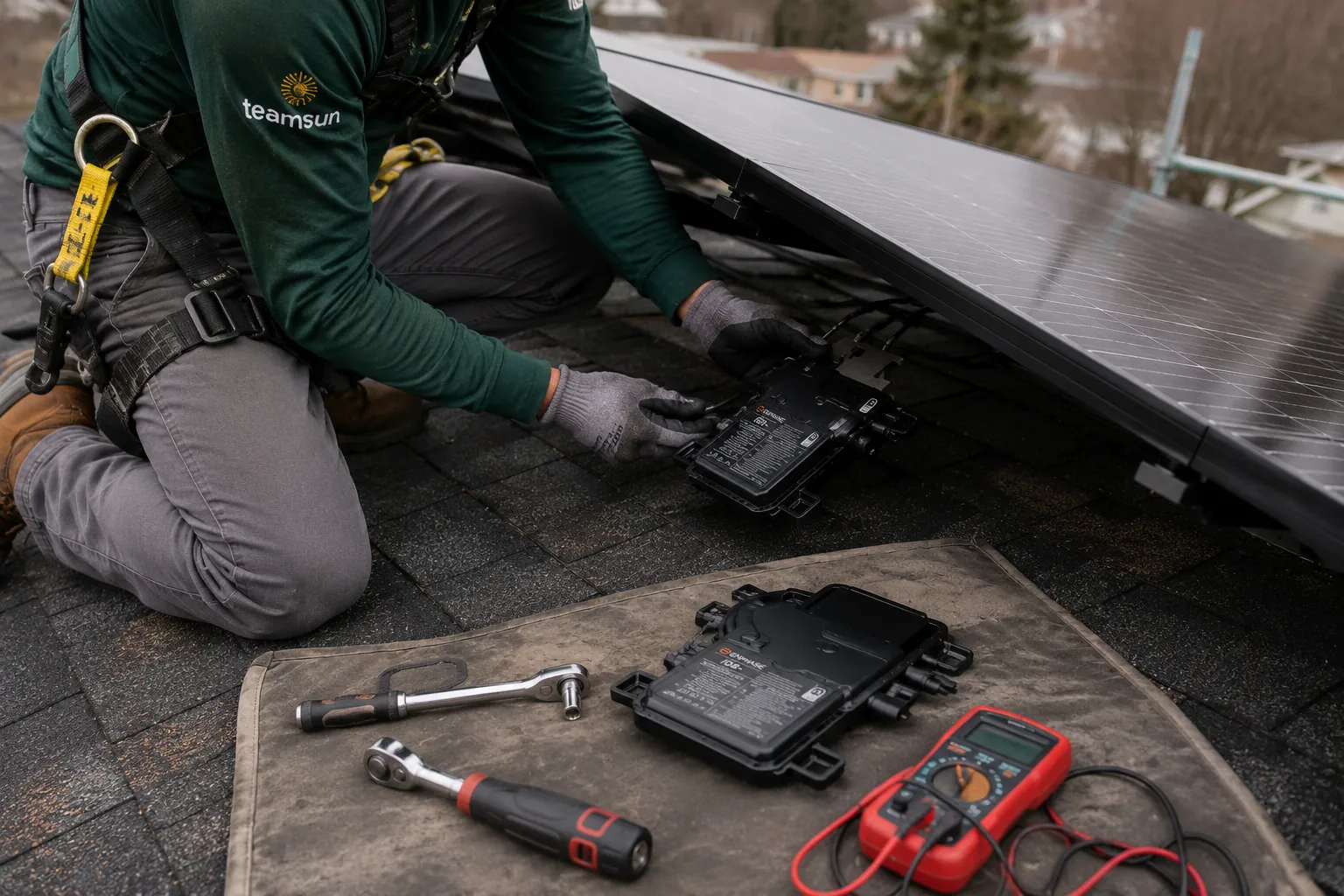
Panels, inverters, racking, conduit, monitoring hardware, and all wiring required to make the commercial system work.

The federal commercial ITC covers up to 40% of your solar and battery costs when domestic-content and energy-community bonuses stack. Residential ITC no longer applies in New England — but with our high energy costs, our systems will always save residential customers money without it. Teamsun provides the cost basis your CPA needs to claim the commercial credit.
By the numbers
Not tax advice
This page summarizes the federal commercial Investment Tax Credit at a high level. Teamsun provides the cost-basis documentation and system specifications your tax preparer needs, but we do not give tax advice. Residential ITC no longer applies in New England. Your situation may differ — always consult a qualified CPA before claiming any federal tax credit.
The IRS treats the eligible cost basis broadly — equipment, labor, and the soft costs required to put the system in service. Roof replacement and unrelated electrical work are excluded.
Panels, inverters, racking, conduit, monitoring hardware, and all wiring required to make the commercial system work.
Commercial batteries 3 kWh or larger qualify — including standalone batteries with no solar attached.
On-roof labor, electrical work, permitting fees, and inspection costs — every line on your Teamsun invoice that is part of installing the commercial system.
Sales tax paid on eligible equipment is included in the cost basis. Connecticut exempts solar from sales tax outright; MA and RI handle it differently.
The credit is claimed once, in the tax year your system receives Permission to Operate. Your CPA files; we hand you everything they need.
Your Teamsun commercial system is commissioned and receives Permission to Operate (PTO) from your utility. The credit is claimed in the tax year your system goes live.
Teamsun provides a single-page cost-basis document showing every eligible expense — equipment, labor, permits, sales tax — with your invoice and system specs attached.
Your tax preparer claims up to 40% of eligible costs as a non-refundable credit on your federal commercial return, applying domestic-content and energy-community bonuses where available.
If the credit exceeds your tax liability in year one, the remainder carries forward to future tax years. Speak with your CPA about your specific carryforward situation.
The four documents on every Teamsun project file. Sent to you in PDF on the day your system goes live.
Single-page summary of eligible costs, broken out by category — exactly what your CPA needs to file the commercial credit.
Panel make and model, inverter model, battery capacity, system-level kW DC and AC ratings — required for the IRS to substantiate the credit.
Your PTO letter from the utility, which establishes the tax year for claiming the credit.
If your return is ever audited regarding the solar credit, Teamsun provides supporting documentation directly. You do not chase us for paperwork five years later.
“Teamsun was the only crew that walked the roof, named the panel brand, and answered every question without checking with someone. Same lead tech came back a year later when I added a battery.”

“Three of my neighbors had Teamsun, so I called them. The crew was on my street five days after I signed.”

“They knew the historic district secretary by first name. Saved us six weeks on permitting alone.”

“Same lead tech who installed it came back four years later to swap an inverter under warranty. No charge, no excuses.”
The commercial Investment Tax Credit is a non-refundable federal income-tax credit on the cost of installing a commercial solar electric, battery storage, or related clean energy system. The base rate stacks up to 40% with domestic-content and energy-community bonuses. The residential version has been removed in New England — this page is about the commercial credit.
No — residential ITC no longer applies in New England. The good news is that with our high regional energy costs and the state-and-utility stack (CT ESS minimum $5,000, MA Connected Solutions, full retail net metering, property and sales tax exemptions), our systems will always save you money without it. Our residential proposals model the math without assuming any federal credit.
The base commercial federal ITC starts at 30% and stacks up to 40% with domestic-content and energy-community bonuses. MACRS depreciation is a separate stacking benefit on commercial projects. Always verify the current rate and bonus eligibility with your CPA at the time you file.
Yes — commercial batteries with a capacity of 3 kWh or greater qualify, including standalone batteries with no solar attached. Every battery Teamsun installs (FranklinWH, Tesla Powerwall, Enphase IQ Battery 5P) exceeds the 3 kWh threshold.
No. On a commercial lease or PPA, the third-party owner of the system claims the credit. Your business benefits indirectly through a lower fixed rate per kWh. Cash and loan structures let the commercial owner claim the credit directly.
The unused portion carries forward to future tax years. The credit is non-refundable — meaning it cannot reduce your tax bill below zero — but the carryforward lets most commercial owners claim the full credit over 1 – 3 years. Check with your CPA about your specific carryforward window.
No. We provide the cost-basis documentation, system specifications, and PTO letter your CPA needs. We are not a tax preparation service. Always work with a qualified tax professional.
No. The credit is claimed in the tax year the system is placed in service (PTO date). If you missed claiming it on the original return, you can amend prior tax returns within the IRS amendment window — speak with a CPA about whether amending is worthwhile.
Generally no. The credit applies to solar costs only, not to a re-roof project that happens to include solar. Narrow exceptions exist for solar-shingle hybrid products that integrate panels into the roof itself. A standard asphalt-shingle re-roof under your panels is not eligible. Speak with your CPA.
Keep your Teamsun invoice, our cost-basis summary, the PTO letter from your utility, and a copy of the filed return — for at least seven years per general IRS guidance. Teamsun maintains a copy of your project file for as long as we operate.
Commercial guides
Homeowner guides
Tell Teamsun about your property, energy goals, and questions. We will help you identify the right next step for the project.
Start with the property
Share the address,
utility, and project goal.
Confirm availability
Teamsun will confirm
coverage for your address.
Match the next step
Solar, storage, roofing,
EV charging, or service.