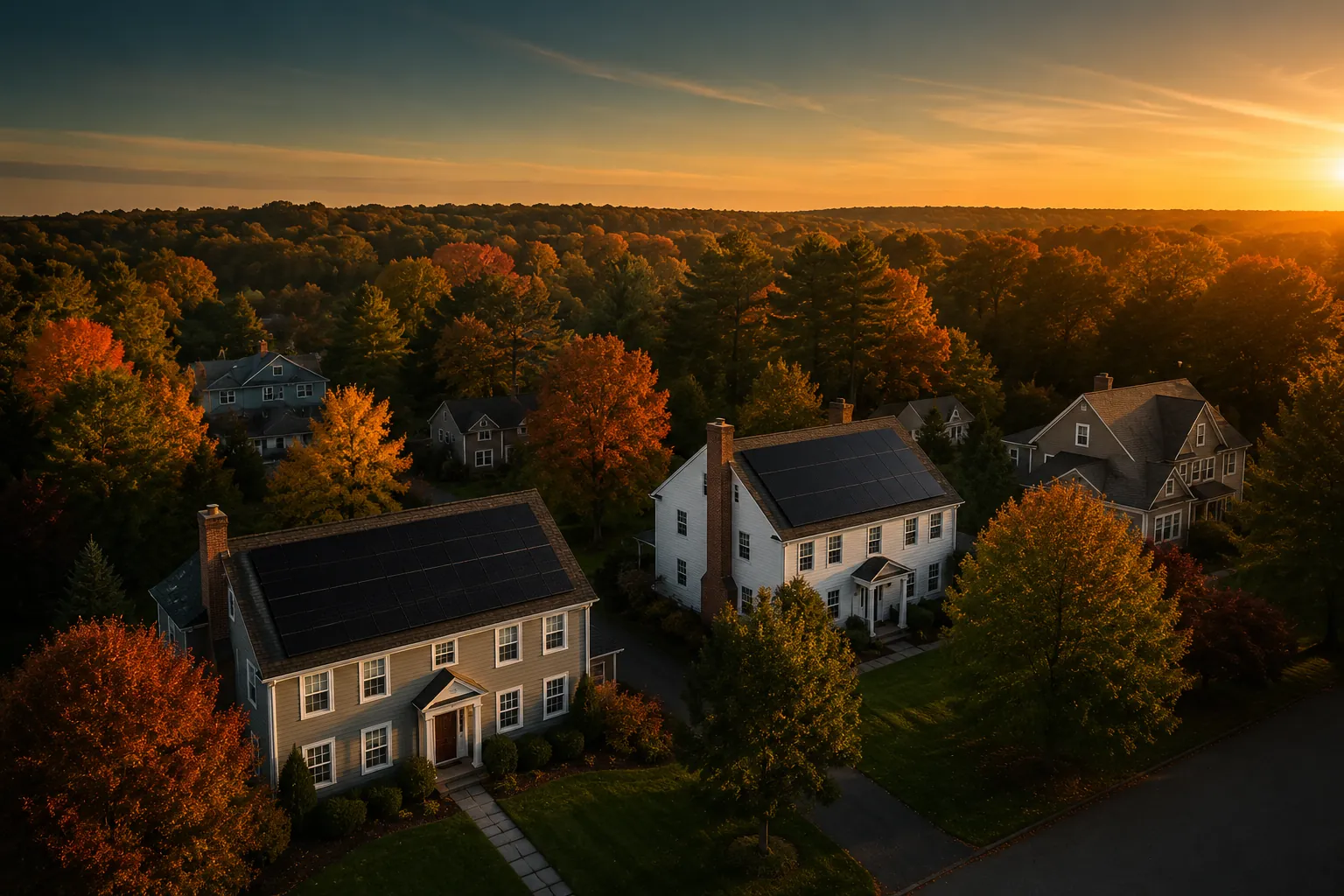
Solar Installation in Greenwich: Eversource & Permits
Compare Greenwich solar installers using 2026 Eversource RRES rules, Town permits and fees, historic and site reviews, roof scope, and complete quotes.
Dan Katzman
Founder, Teamsun
A solar installer in Greenwich, CT should not quote from a ZIP code and an annual electric total alone. A defensible proposal starts with the Eversource account, the Town’s permit records, the roof and electrical service, and the parcel’s historic, coastal, flood, wetlands, zoning, and association constraints. It then shows the 2026 Residential Renewable Energy Solutions tariff, cash price, financing, responsibility, and closeout records separately.
This is an address-level buying guide, not a ranking of Greenwich solar companies. Teamsun benefits if you request a proposal from us, so apply every checklist here to Teamsun and every other bidder. We have not used unverified claims about Teamsun projects, crews, credentials, prices, or approval times in Greenwich.
Greenwich quick answer: Verify Eversource on the bill. Pull Town records and map the parcel. Decide whether historic, coastal, flood, wetlands, zoning, or association review applies. Require a roof and electrical survey. Compare Buy-All and Netting with 2026 inputs. Finally, make the contract assign every Town, Eversource, inspection, meter, warranty, and closeout task by legal entity.
What should happen before a Greenwich solar quote?
The first proposal should be a conditional design, not a final promise. Greenwich properties can differ materially even when they share a street or ZIP code. A roof-only project on a recently built inland home may follow a simpler path than a project on a local historic property, a coastal parcel, an older roof, or a site that also needs trenching, vegetation work, a service upgrade, or a ground-mounted array.
Give every bidder the same starting file:
- the service address and a recent complete Eversource bill;
- 12 months of electricity consumption when available;
- a list of planned electric vehicles, heat pumps, pool equipment, additions, or batteries;
- roof age, roof material, warranty, repair history, attic access, and any known leaks;
- property survey, plot plan, Town permit history, and any open-permit information you have;
- historic designation, conservation easement, association, or architectural rules known to the owner;
- panel, meter, generator, transfer switch, and service-rating photographs taken safely from ground level; and
- your ownership and financing preferences.
The Town’s Building Inspection page says owners can request surveys, permit reports, building plans, and certificates of occupancy from the building-records office. Those records can reveal a roof replacement, service change, addition, generator, unresolved permit, or existing plan that affects the solar scope. Records do not replace a physical survey, but they prevent a salesperson from designing as if the house has no history.
Use a gate before comparing prices:
| Address gate | Evidence required | What it can change |
|---|---|---|
| Utility | Eversource shown as electric delivery company and correct account class | RRES eligibility, tariff, application, meters, bill model |
| Town records | Permit history, approved plans, CO or compliance records, open items | Application scope, prerequisites, closeout |
| Roof | Material, age, condition, structure, warranty and remaining useful life | Attachment, engineering, reroof timing, warranty |
| Electrical | Service rating, main panel, meter, disconnects, generator and load plan | One-line, equipment placement, upgrade scope |
| Parcel | Zoning, historic, coastal, flood, wetlands, easements and association | Review path, array location, equipment and trenching |
| Economics | Current bill, future loads, 2026 RRES option and finance terms | System size, cash flow, payback sensitivity |
If a bidder refuses to condition the price on a documented survey, require a written list of assumed conditions and maximum or unit-priced adders. “Subject to site survey” without defined consequences gives the seller too much room to rewrite the deal after a deposit.
Is Eversource the electric utility in Greenwich?
Yes. Eversource’s current Connecticut communities-served list includes Greenwich under electric service. Confirm the delivery company on the actual bill anyway. A third-party supplier name can appear on the supply portion, but it does not replace Eversource as the distribution company or interconnection authority.
A complete Greenwich proposal should identify four bill concepts separately:
- electricity supplied to the property;
- Eversource delivery and other regulated bill components;
- solar used on site or exported under the selected RRES structure; and
- charges or credits that remain after solar.
Do not accept one blended “electric rate” multiplied by production for 25 years. Connecticut supply rates and regulated bill components can change. In 2026, PURA also approved rate-component adjustments effective May 1. The Connecticut Office of Consumer Counsel’s electric-bill guide separates supply, transmission, local delivery, and public-benefits categories and notes that customers may choose a supplier. Your proposal should reveal which components it assumes solar will avoid, offset, or leave payable.
How 2026 RRES changes the quote
Connecticut’s Residential Renewable Energy Solutions program replaced legacy residential net metering for new participants and is administered by Eversource and United Illuminating. The PURA RRES page says its latest annual review updated tariff rates and application fees for projects enrolling in 2026.
For an eligible Greenwich one-to-four-family property, the current Eversource page shows these 2026 inputs:
| RRES structure | What the meter arrangement does | 2026 input the quote must show |
|---|---|---|
| Buy-All | All qualifying solar production is exported and purchased; the home continues buying its electricity | $0.3289 per kWh base rate for approved 2026 applications, including REC value |
| Netting | The home uses production and exported energy receives the applicable on-bill credit | $0 base REC rate plus a $0.0402-per-kWh Solar Energy Adjustment charged on total solar production for 2026 applications |
Eversource publishes those figures on its current Connecticut residential solar incentives page. The page also describes a 20-year tariff term, metering, payment choices under Buy-All, and possible income-based adders subject to eligibility. An installer must not treat an adder as available merely because the homeowner lives in Fairfield County or Greenwich.
Neither option is automatically superior. Ask for both models when both apply, using the same design, production estimate, financing, degradation, and utility-rate scenarios. Under Buy-All, show solar-production compensation and the continuing household bill as separate streams. Under Netting, show self-consumption, exports, fixed bill components, export credits, and the Solar Energy Adjustment separately.
Require these assumptions in a downloadable worksheet:
- application year and tariff option;
- DC system size, AC inverter capacity, and year-one production;
- hourly or monthly consumption basis;
- future EV, heat-pump, pool, battery, or addition loads;
- Buy-All payment treatment or Netting self-consumption and export treatment;
- the 2026 Solar Energy Adjustment on total production;
- retail-rate source, date, components, and escalation assumption;
- degradation, downtime, shading, snow, and weather assumptions; and
- a no-rate-escalation and 10%-lower-production sensitivity case.
A screenshot of a savings curve is not enough. It should be possible to change one input and see the result.
Teamsun crews reach Greenwich from the same dispatch area that covers Bridgeport, so the permitting, utility, and inspection routine described here is the one our field team already runs locally.
How do Eversource interconnection and Town approval fit together?
They are separate approval tracks that eventually meet. A Greenwich building or electrical approval does not authorize export to the Eversource grid, and an Eversource application does not replace Town permits or inspections.
Eversource’s Connecticut application-to-connect page uses PowerClerk for application submission and lifecycle tracking. The portal identifies the current step and responsible party. The same page lists a $200 interconnection application fee for residential inverter-based generators of 50 kW or less. RRES can have additional program requirements and fees, so the proposal must identify each fee by name instead of combining them into an unexplained “utility fee.” Recheck fees when filing.
Before installation, ask for the PowerClerk project identifier and evidence of the approval milestone required to build. Before activation, require the Town inspection result, the utility’s meter-work status, and written Eversource authorization. Never energize or export merely because panels have been mounted.
Use this responsibility table in the contract:
| Milestone | Named responsible entity | Record the owner should receive |
|---|---|---|
| RRES customer disclosure and selection | Signed disclosure and selected tariff | |
| Interconnection application | PowerClerk ID, submitted design, fee receipt | |
| Utility corrections | Questions, revised documents, acceptance | |
| Town building permit | Filed application, plans, invoice, issued permit | |
| Electrical permit | Application, contractor/license, issued permit | |
| Other parcel reviews | Determination, sign-off, certificate or approval | |
| Town inspections | Scheduled inspections and results | |
| Utility meter work | Meter request and completion status | |
| Permission to energize/operate | Written Eversource authorization | |
| Monitoring handoff | Owner login, baseline, manuals and contacts |
This prevents a common handoff failure: the salesperson blames engineering, the installer blames the permit office, and both assume the homeowner will chase Eversource.
What permits and fees apply to Greenwich solar panels?
Greenwich expressly lists adding solar panels to a building or erecting a freestanding array as work requiring a building permit. Electrical work requires a trade permit. The Town’s permit-required page is the starting authority, not a neighboring municipality’s checklist.
The current Greenwich building-permit process is unusually important to verify before a salesperson promises a digital-only filing. The Town currently says only one- and two-family reroofing, re-siding, and replacement-window permits may be submitted by email. All other building permits must be filed in person. A solar building permit therefore should be planned as an in-person filing unless Building Inspection confirms a changed procedure for the exact application.
The electrical application can follow its own process. The Town’s electrical-permit guidance says an electrical permit application is required and may be submitted in person or by email. It also says electrical services greater than 400 amps require professional-engineer load calculations. That rule can matter on properties with large services, generators, multiple buildings, pools, or extensive existing loads. Do not assume a standard residential one-line is sufficient.
After issuance, inspections are scheduled through City Squared. Greenwich states that the old inspection-request email stopped operating on February 3, 2025. Its City Squared inspection page says the portal lets owners and contractors schedule inspections and view permit status, results, and issuance conditions.
Current posted fee workflow
The Town’s current permit fee schedule lists:
- a $40.26 minimum residential building fee;
- $13.26 per $1,000, or major fraction, of residential work valuation;
- valuation that includes mechanical trade costs;
- required mechanical trade permits with no separate fee when covered by the building permit;
- a 5% surcharge on the permit fee when the structure was built before 1940; and
- a $40 minimum and $12 per $1,000, or major fraction, for an electrical permit when separately charged.
These are schedule inputs, not a universal solar-permit price. Ask the contractor to show the declared valuation, fee calculation, trade permits included, any state or departmental charges, and the final Town invoice. Recheck the posted schedule immediately before filing. The contract should say who pays a fee change and whether permit costs are included in the fixed price.
The permit packet should match the final system
At minimum, expect the permit team to coordinate a site or roof plan, array layout, structural or attachment information, equipment specifications, electrical one-line, equipment locations, disconnects, labeling, contractor credentials, and any additional sign-offs the address triggers. The exact packet is set by the Town and project, not by this article.
Do not let the installer make an equipment or layout substitution after approval without checking whether revised Town and Eversource documents are required. At closeout, the module count, inverter model, array layout, battery, disconnects, meter configuration, and owner records should agree.
Roof and solar together
Solving the roof after the panels are up costs far more.
If the roof is within a decade of replacement, Teamsun sequences re-roofing and solar on one timeline so the array is never removed and reinstalled at your expense.
Does a Greenwich property need historic or design review?
It depends on the property’s exact designation and the proposed exterior change. “Old house,” “historic neighborhood,” a Greenwich Historical Society plaque, National Register listing, Local Historic Property status, Historic Overlay status, and a Local Historic District are not interchangeable.
The Town’s current Historic District Commission map page says properties in Local Historic Districts, Local Historic Properties, and Historic Overlay zones must receive a Certificate of Appropriateness before proposed work proceeds. It describes National Register properties as following an HDC advisory-opinion review. Confirm the designation and current required filing directly with Town staff; an online map is a screening tool, not a final legal determination.
Greenwich currently identifies three Local Historic Districts: Strickland Road/Mill Pond Court, John Street/Round Hill Road, and Stanwich. It also lists Local Historic Properties and more than 90 Historic Overlay properties. The local-versus-National-Register explanation reinforces that local designation carries regulatory review while National Register listing alone has a different effect.
If a Certificate of Appropriateness applies, start before final engineering. The HDC page says application and presentation materials must reach members and the secretary at least two weeks before the posted meeting. State historic-district law also treats solar specifically: a commission cannot deny a renewable-energy exterior feature unless it finds that the feature cannot be installed without substantially impairing historic character, but it may require location or design modifications that do not significantly impair effectiveness. That is not automatic approval for the bidder’s first layout.
Ask the designer to prepare alternatives that preserve production evidence:
- primary roof plane versus less-visible plane;
- module geometry aligned with roof edges and architectural features;
- all-black or visually consistent equipment where technically and commercially appropriate;
- conduit and disconnect locations coordinated with existing exterior elements;
- equipment screening that preserves ventilation, clearances, access, and code compliance; and
- a production comparison showing the energy effect of each acceptable layout.
The Town’s Architectural Review Committee page describes ARC review as advisory to Planning and Zoning for matters within its jurisdiction. Do not state that every residential rooftop array needs ARC review. Ask Planning and Zoning whether the specific property, prior approval, use, exterior alteration, or application type triggers ARC, HDC, both, or neither.
When do coastal, flood, wetlands, or zoning rules matter?
These are parcel and scope questions, not blanket requirements for every Greenwich roof. A flush-mounted array with no ground disturbance may have a different review path from a ground mount, trench, battery pad, service relocation, tree work, accessory structure, or roof alteration. Screen all conditions, then document which reviews do and do not apply.
Coastal and flood screening
Greenwich’s Planning and Zoning FAQ says FEMA determines flood-zone boundaries and identifies Section 6-139.1 of the Town’s Building Zone Regulations for the Flood Hazard Overlay Zone. It separately points to Section 6-111 for the Coastal Overlay Zone. The Town’s land-use page includes a Coastal Area Management application and FEMA elevation and substantial-improvement forms.
For a potentially affected address, obtain:
- the current FEMA determination or map panel;
- the Town zoning and coastal-overlay status;
- any elevation certificate already on file;
- prior coastal site-plan, variance, or flood-related approvals;
- proposed equipment elevations and attachment details; and
- a written determination of whether the solar, battery, trench, pad, service, or roof scope triggers further review.
A rooftop array does not automatically become a flood project, and a coastal Greenwich address does not automatically require the same application for every alteration. Conversely, moving electrical equipment, placing a battery outdoors, installing a ground-mounted disconnect, or altering a roof as part of a larger project can make location and elevation relevant. Get the Town’s project-specific answer before the contract treats the site as ordinary.
Inland wetlands and drainage screening
The Greenwich Wetlands Department says projects involving digging, construction, landscaping, or alteration of ground or vegetation must be reviewed by staff to determine whether wetlands, watercourses, or drainage systems are nearby. The Town uses a permit-need questionnaire commonly called a Green Sheet, submitted with a site plan.
This can apply even when the modules are on a roof if the project also includes:
- underground conduit;
- a ground mount or equipment pad;
- access or staging that disturbs protected areas;
- drainage or grading changes;
- vegetation or tree work; or
- work near a watercourse or mapped wetland.
The Town’s GIS and wetland maps are useful screening tools, but Greenwich expressly warns that map data is periodically updated and disclaims accuracy. Treat staff determination and field conditions as controlling. Put the required wetland determination, application, or sign-off in the contract scope instead of assuming “no permit” from an aerial image.
Zoning and existing approvals
Greenwich Zoning Enforcement says every zoning-permit application and some trade permits receive zoning-compliance review before Building Inspection accepts them. It also enforces coastal flood-hazard rules. A rooftop array may be straightforward, but ground arrays, detached structures, equipment placement, prior special permits, easements, lot constraints, or nonconforming conditions can add review.
Ask the installer to identify:
- the parcel’s zone and overlays;
- whether a zoning permit or sign-off is required;
- whether an existing site plan, variance, special permit, or deed restriction limits the layout;
- whether equipment placement changes setbacks, screening, access, or drainage; and
- who obtains and closes every approval.
An “approved solar design” is incomplete until it is approved for this parcel, not merely technically compatible with the roof.
How should the roof and electrical service change the design?
A solar layout must fit the building for decades, not just fit enough modules into an aerial rectangle. Greenwich’s permit fee schedule even treats pre-1940 structures differently for fees, which is a reminder to verify construction age and records. Age alone does not make a building unsuitable, but it can make documentation, structure, materials, and prior alterations more important.
Roof diligence before array design
Require a written roof report covering:
- roof type, approximate installation date, permit record, and manufacturer warranty;
- active leaks, past repairs, flashing, penetrations, valleys, hips, ridges, drains, gutters, and low-slope areas;
- deck and framing observations available from accessible areas;
- attachment method, flashing or waterproofing detail, fastener, and structural basis;
- snow, wind, dead-load, and uplift design responsibility;
- code access pathways and firefighter clearances;
- module removal and reinstallation responsibility if roofing work becomes necessary; and
- separate workmanship, roof-penetration, and roofing warranty terms.
If the roof may need replacement during the system’s expected service life, price three alternatives before signing: install now, reroof first, or combine roof and solar under one coordinated scope. Our solar and roofing company guide explains how to assign responsibility between trades. Do not let one party’s warranty silently exclude damage associated with the other party’s work.
On slate, tile, cedar, metal, membrane, low-slope, or architecturally sensitive roofs, ask for the exact attachment and weatherproofing method and comparable-project evidence. Do not assume a product or crew is qualified for every roof material. A premium module does not compensate for an unsuitable attachment.
Electrical and resilience diligence
The survey should record service rating, panel model and condition, available breaker space, bus rating, meter location, disconnects, grounding and bonding, generator, automatic transfer switch, surge protection, and any battery plan. The design must also account for future EV charging, heat pumps, pools, additions, and outbuildings.
For services above 400 amps, require the professional-engineer load calculations Greenwich calls for. For any service change, ask whether Eversource coordination, Town electrical work, meter equipment, trenching, or additional lead time is excluded from the base quote.
Solar alone normally shuts down during a grid outage for worker safety. If outage backup is a purchase objective, specify backed-up loads, starting currents, desired duration, generator interaction, battery location, transfer equipment, and black-start behavior. “Battery ready” is not an engineered backup design. A battery also adds manufacturer, fire, electrical, utility, location, and service questions that should be priced explicitly.
How much should a Greenwich solar quote include?
There is no defensible universal Greenwich solar price. Current SERPs publish averages and instant estimates, but an address-specific price changes with system size, roof material and planes, shade, structural work, electrical service, permits, historic or land-use review, trenching, storage, equipment, ownership, and financing.
Begin with the gross cash price before incentives and financing. Then calculate:
Gross cash cost per watt = gross installed cash price ÷ DC system watts
Use the result only as a normalization tool. A lower value can omit reroofing, structural work, service upgrades, permit fees, production monitoring, warranty labor, or difficult attachments.
| Quote line | Required disclosure | Red flag |
|---|---|---|
| Gross cash price | Complete installed cash price before incentives and finance | Only a monthly payment is shown |
| System | Module count × module watts, inverter AC rating, year-one kWh | Different sizes compared by total price |
| Equipment | Exact modules, inverters, racking, monitoring, battery and substitution rule | “Or equivalent” without owner approval |
| Roof and structure | Inspection findings, attachment, engineering, repairs and exclusions | Roof suitability declared from satellite imagery |
| Electrical | Panel, service, disconnect, meter, generator and upgrade scope | All electrical adders deferred |
| Town | Building, trade and conditional reviews; valuation and fees | “Permits included” with no responsible entity |
| Eversource | RRES option, PowerClerk, fees, corrections, meters and final authorization | Generic “net metering” line |
| Finance | Cash price, financed principal, rate, term, fees, payment changes, total payments | Dealer fee hidden in system price |
| Warranty | Product, workmanship, roof, labor, shipping, access, exclusions and provider | One “25-year warranty” label |
| Closeout | Plans, permits, inspections, authorization, manuals and logins | No owner record package |
Get at least three proposals on the same data. Connecticut DCP’s current home-improvement guidance recommends speaking with several contractors, verifying registrations, and asking for references to similar work. A marketplace quote and a direct-installer quote can both be useful, but identify who actually contracts, installs, pulls permits, handles Eversource, and services the system. Our installer-versus-marketplace guide provides the full responsibility test.
Compare production, not just equipment wattage
Require a shade study and production model showing orientation, tilt, roof planes, module-level losses, inverter clipping, soiling, weather data, degradation, and any historic-review design alternative. If tree work is assumed, identify who owns it, whether a wetlands or tree review applies, and whether the production guarantee depends on it.
Stress-test each model:
- zero utility-rate escalation;
- production 10% below estimate;
- one material repair event outside warranty;
- reroof and array removal during the ownership period;
- a home sale or financing payoff; and
- future load materially higher or lower than forecast.
The winning proposal is not automatically the one with the shortest modeled payback. It is the one whose result remains acceptable when assumptions move.
Greenwich projects
Get a proposal built around Greenwich conditions.
Teamsun handles the permit filings, Connecticut program paperwork, and utility interconnection for projects in this area, and quotes against your actual bill rather than a regional average.
Which taxes and financing assumptions are current in 2026?
The federal homeowner credit changed. The IRS says the Residential Clean Energy Credit applied to qualified property installed through December 31, 2025 and is not available for property placed in service after that date. Its current Section 25D page also explains that timing follows installation, not simply payment.
Therefore, a homeowner-owned Greenwich system placed in service in 2026 should not be shown with a 30% Section 25D reduction in the base economics. If a proposal does, require the seller to remove it and recalculate. Prior-year carryforwards, mixed residential and business use, third-party ownership, trusts, and other structures require advice from a qualified tax professional. The installer is not the homeowner’s tax adviser.
Connecticut DRS currently lists solar electricity-generating systems among sales-and-use-tax exemptions and identifies CERT-140. Ask whether the exemption is reflected in the gross price and retain the certificate or transaction record. Do not let a salesperson call a tax exemption a cash rebate.
Connecticut property-tax law provides an exemption path for qualifying private-residential Class I renewable systems, subject to statutory conditions, and state regulations tie eligibility to permits, zoning, and applicable utility requirements. Greenwich’s Assessor maintains the Grand List and reviews tax-exempt property. Because ownership, property use, system size, annual-load relationship, and documentation can matter, confirm the address’s treatment with the Greenwich Assessor rather than subtracting an assumed property-tax benefit from the quote. Connecticut’s new uniform solar-capacity tax applies to defined systems over one megawatt and expressly excludes residential rooftops; it is not a new annual tax on an ordinary residential rooftop array.
Compare financing by total obligation
For cash, home-equity credit, an installer loan, Smart-E, lease, or power purchase agreement, compare ownership and total cash flow rather than “no money down.” The Connecticut Green Bank’s current Smart-E page says the program works through participating contractors and local lenders. The Green Bank is not a promise that any contractor, borrower, project, rate, or term qualifies. Verify the current lender offer and contractor participation directly.
For every loan, require:
- cash price and financed principal;
- interest rate and annual percentage rate;
- term, payment schedule, fees, and total of payments;
- whether principal is expected to be prepaid or re-amortized;
- security interest, lien, UCC filing, or transfer effects;
- prepayment rules and payoff process; and
- what happens when the home is sold or refinanced.
For a lease or PPA, require ownership, starting payment or energy rate, escalator, term, production obligations, maintenance, insurance, roof removal, transfer, early termination, buyout timing and formula, and end-of-term options. Never accept a projected third-party tax benefit as if it were a guaranteed homeowner discount.
If you want an address-specific scope built around Greenwich records and Eversource inputs, request a solar quote from Teamsun. Confirm Teamsun’s current service availability and credential chain for the property as part of the consultation.
How do you verify a Greenwich solar installer?
Verify the legal entity, not just a trade name or salesperson. Connecticut DCP says Home Improvement Contractors and Home Improvement Salespeople must be registered and directs homeowners to the eLicense portal. Use DCP’s license-verification instructions to match name, credential type, status, and expiration.
Solar electrical scopes are separate. DCP’s solar-trades guidance says PV-1 and PV-2 holders may perform limited solar-electric work but may not connect to an existing panel, junction box, building circuit, wiring, or utility meter. That connection requires an E-1 or E-2 license holder.
Ask each bidder for this entity map:
| Role | Legal name | Credential/insurance | Contract duty |
|---|---|---|---|
| Seller and HIC | Price, disclosures, cancellation | ||
| Site surveyor | Roof, shade, electrical and parcel inputs | ||
| Designer/engineer | Plans, calculations, revisions | ||
| Roofing contractor | Roof work and warranty, if applicable | ||
| Solar installer | Racking, modules, wiring within scope | ||
| Electrical contractor | Existing-system connection and electrical permit | ||
| Town permit applicant | Filing, corrections and inspections | ||
| Eversource applicant | RRES, interconnection, meter and authorization | ||
| Service provider | Monitoring, troubleshooting and warranty labor |
Check insurance certificates with the carrier or agent and confirm the named insured matches the entity performing the work. Ask whether employees, subcontractors, or both will work on site; neither model guarantees quality, but undisclosed handoffs make accountability hard to enforce. Our solar contractor license guide covers the detailed lookup workflow.
Then request comparable evidence. “We work in Connecticut” is not Greenwich proof. Useful evidence includes redacted Town permits, Eversource closeout records, roofs of similar material and complexity, historic or overlay review when relevant, owner references with permission, and monitoring that shows the installed design. Verify every claim independently.
Teamsun has not supplied this article with a verified Greenwich project list, local permit set, crew roster, price sample, approval-time dataset, or customer reference. Ask Teamsun for the same evidence before choosing us.
What must the Connecticut contract say?
The contract should turn the proposal into enforceable responsibility. Connecticut DCP’s April 2026 home-improvement contract guidance says the written agreement must include the HIC number; signature, start, completion, and cancellation dates; the full agreement and price; materials; permit responsibility; payment schedule; and a notice of the three-business-day cancellation right.
For Greenwich solar, add these schedules or exhibits:
- Final scope: exact equipment, system size, layout, roof attachment, electrical work, monitoring, and exclusions.
- Address conditions: Town records, roof findings, service rating, parcel overlays, association, and conditional reviews.
- Economics: gross cash price, finance terms, RRES option, production model, utility assumptions, and tax assumptions.
- Milestones: engineering, HDC or land-use review if applicable, Town permits, Eversource acceptance, installation, inspections, meter work, and authorization.
- Change orders: who may approve, documentation required, unit prices or caps, and cancellation rights if scope materially changes.
- Payment: amounts tied to verifiable work rather than vague “project progress.”
- Warranty: equipment, workmanship, roof penetrations, labor, access, shipping, exclusions, transfers, claims, and provider identity.
- Closeout: the complete owner record package and final payment condition.
Do not allow a final contract to live only in an expiring electronic-signature link. Download the proposal, disclosures, finance agreement, warranty, and signed contract before the link expires. Forum discussions from Connecticut homeowners repeatedly raise this practical problem, along with surprise fees, unclear payment milestones, and verbal promises that do not appear in the agreement. Those discussions identify questions; official documents and the signed contract control the answer.
Use our solar warranty comparison guide to separate module, inverter, battery, workmanship, roof, performance, and service coverage. A “25-year warranty” does not say who pays for diagnosis, labor, shipping, roof access, or removal and reinstallation.
Next step
Turn this guide into a decision you can act on.
Teamsun reviews your bills, roof, and any proposals you already hold, then puts the options in writing. No obligation to buy.
What records should you receive before final payment?
Closeout is the last buying decision, not administrative clutter. The owner should be able to prove what was approved, what was built, who is responsible, and when operation was authorized.
Require a digital folder containing:
- signed contract, amendments, change orders, customer disclosure, and finance documents;
- final equipment schedule with models and serial numbers;
- approved Town building, electrical, zoning, HDC, wetlands, coastal, flood, or other documents that applied;
- final stamped or approved plan set and as-built changes;
- Town inspection results and certificate or compliance record required for the project;
- RRES selection, PowerClerk application, Eversource correspondence, meter record, and written authorization to energize or operate;
- manufacturer registrations, warranties, workmanship and roof coverage;
- monitoring login owned or controlled by the homeowner;
- shutdown, rapid-shutdown, emergency, battery, and generator instructions;
- baseline production expectation and commissioning results;
- photos of concealed or roof attachment work when available; and
- service, escalation, roofing, electrician, financier, and utility contacts.
Compare the final array against the documents before paying the closeout balance. Check module count, equipment models, inverter size, battery, disconnects, meter arrangement, monitoring, and layout. Resolve substitutions in writing and confirm revised approvals where required.
Also record open items with owners and dates: monitoring communications, inspection corrections, landscaping restoration, labels, roof touch-ups, account transfers, or utility billing changes. Permission to operate does not prove every contractual item is finished.
Which Greenwich solar red flags should stop the purchase?
Pause when a seller cannot produce evidence for a claim that materially affects price, permission, or service.
- The 2026 proposal subtracts a 30% federal homeowner credit for a system expected to be installed after 2025.
- The savings model says only “net metering” and omits Buy-All, Netting, application year, and the Solar Energy Adjustment.
- The seller does not verify Eversource from the account or separate supply from delivery.
- The company promises a universal Greenwich permit or activation time without screening the property.
- The installer says all permitting is online even though the Town currently requires most building permits, including solar, to be filed in person.
- A historic address is treated as ordinary without checking local district/property, overlay, easement, or National Register status.
- Coastal, flood, or wetland maps are used to declare approval rather than to request a Town determination.
- Roof suitability is based only on aerial imagery, or the contract excludes every leak and attachment issue.
- A service over 400 amps is treated as standard without addressing Greenwich’s engineer-load-calculation rule.
- Only a PV license is shown for work connecting to the existing panel or utility meter.
- The seller, installer, electrician, permit applicant, Eversource applicant, financier, and warranty provider cannot be connected by legal name.
- The price is presented only as a payment or post-incentive number.
- Equipment substitutions, roof work, structural work, panel upgrades, permit fees, and utility charges remain undefined after a large deposit.
- Reviews or project photos cannot be tied to the legal entity and comparable local scope.
- Final payment is due before inspections, Eversource authorization, monitoring, and the owner record package.
Pressure is also a red flag. An official program deadline should be traceable to PURA or Eversource, not a salesperson’s countdown clock. Take the contract away from the sales meeting, download every document, and obtain independent tax, legal, insurance, roofing, or financing advice when the issue falls outside the installer’s role.
Frequently asked questions about solar installation in Greenwich
Who provides electric service in Greenwich, Connecticut?
Eversource lists Greenwich in its Connecticut electric territory. Verify Eversource as the delivery company on the actual account because a third-party supply company may also appear on the bill. Eversource remains the relevant distribution and interconnection entity for an ordinary grid-connected Greenwich account in its territory.
Do solar panels require a Greenwich building permit?
Yes. The Town expressly lists rooftop and freestanding solar panels as work requiring a building permit. Electrical work also requires its trade permit. The exact project may need zoning, historic, wetlands, coastal, flood, or other review depending on address and scope.
Can a Greenwich solar building permit be filed online?
Do not assume so. Greenwich currently says only one- and two-family reroofing, re-siding, and replacement-window building permits can be emailed, while all other building permits must be filed in person. Inspections are scheduled and tracked through City Squared. Confirm the current procedure at filing.
How much is a Greenwich solar permit?
The posted schedule uses project valuation rather than a single solar price. It currently lists a $40.26 residential building minimum and $13.26 per $1,000 or major fraction of work valuation, plus a 5% permit-fee surcharge for pre-1940 structures. Trade-fee treatment depends on whether it is covered by the building permit. Recheck the schedule and final invoice.
Does a historic Greenwich home need HDC approval for solar?
It depends on the designation. Local Historic District, Local Historic Property, and Historic Overlay status can require a Certificate of Appropriateness. National Register-only status follows a different advisory-review path according to the Town. Confirm the parcel and required filing with HDC before final design.
Does every Greenwich solar project need coastal, flood, or wetlands review?
No universal rule applies to every roof. Screen the address and scope. Ground disturbance, trenching, pads, vegetation work, equipment relocation, a ground mount, coastal-overlay status, or a flood-zone condition can trigger determinations or applications that a simple inland rooftop project may not need.
What are the 2026 Eversource RRES rates?
Eversource currently lists a $0.3289-per-kWh Buy-All base rate for approved 2026 applications. It lists a $0 base Netting REC rate and a $0.0402-per-kWh Solar Energy Adjustment on total production for Netting projects applying in 2026. Verify rates and eligibility when applying.
Is the 30% residential federal solar credit available in 2026?
No for property placed in service after December 31, 2025, according to the current IRS Residential Clean Energy Credit page. A 2026 homeowner proposal should not subtract that credit. Ask a qualified tax professional about prior-year carryforwards or unusual ownership and use facts.
Are Connecticut solar purchases exempt from sales tax?
Connecticut DRS lists solar electricity-generating systems among statutory sales-and-use-tax exemptions and references CERT-140. Confirm the transaction qualifies and keep the certificate or supporting record. An exemption is not a cash rebate.
Does solar increase Greenwich property taxes?
Qualifying private-residential renewable systems have a Connecticut property-tax exemption path, subject to statutory and regulatory conditions. Confirm the address, ownership, property use, size, annual-load relationship, permits, and filing treatment with the Greenwich Assessor. Do not rely on a seller’s blanket promise.
Should I use cash, a solar loan, Smart-E, a lease, or a PPA?
Compare gross cash price, ownership, total payments, rate or escalator, fees, security interests, maintenance, roof work, transfer, payoff or buyout, and end-of-term obligations. Smart-E uses participating contractors and lenders and does not guarantee approval or a particular rate. Get the current documents before deciding.
How many Greenwich solar quotes should I get?
Get at least three proposals based on the same bill, future-load list, ownership plan, and property information. Normalize gross cash price, system size, production, RRES option, roof and electrical scope, fees, financing, warranties, service, and closeout before comparing.
Can Teamsun prove it has installed solar in Greenwich?
This article does not make that claim. Before choosing Teamsun, request current service confirmation, credential and insurance records, crew and subcontractor disclosure, comparable permit and Eversource records, references, warranties, service process, and a site-specific price. Apply the same test to every company.
Sources and methodology
This guide was researched on August 10, 2026. Current local and regulatory claims rely primarily on official sources: Greenwich Building Inspection, permit requirements, permit application process, building forms, City Squared inspections, permit fees, Zoning Enforcement, land-use forms, Historic District Commission, historic parcel map and designations, Wetlands Department, Eversource communities served, Eversource RRES, Eversource interconnection, PURA RRES, DCP home improvement, DCP solar-license scopes, Connecticut DRS exemptions, and the IRS Residential Clean Energy Credit.
We also reviewed current marketplace, installer, cost-page, local-result, and Connecticut forum results to identify what buyers expect and where unsupported claims recur. Those sources informed the questions and content gap; they were not used as authority for fees, approvals, savings, credentials, tax results, project quality, or service performance. No search volume, keyword difficulty, Greenwich cost average, savings figure, installer ranking, or Teamsun local-performance claim was fabricated. Validate demand with Semrush, Ahrefs, Google Search Console, and actual lead data.
This page owns the Greenwich address-to-contract decision. The Connecticut installer guide remains the statewide contractor comparison; Stamford and Fairfield pages cover their own utilities and municipal workflows; the license and warranty pages own their detailed verification methods. A future Greenwich location page should stay concise and link here rather than duplicate this guide.
Get a Greenwich solar quote you can audit
Bring the address, a recent Eversource bill, 12 months of usage, roof and permit records, future electric loads, ownership preference, and known historic, association, coastal, flood, wetlands, or zoning conditions.
Contact Teamsun for a Greenwich solar proposal. Ask us to show the gross cash price, 2026 RRES treatment, roof and electrical findings, permit and Eversource responsibility, financing, warranties, exclusions, and closeout records in writing. Also ask us to verify current Greenwich service availability and provide the credential, crew, insurance, and comparable-project evidence missing from this article before you decide.
Written by
Dan Katzman
Founder, Teamsun
Teamsun writes practical solar guidance to help property owners compare equipment, project scope, costs, and long-term service before making a decision.
Keep going.
Bristol Solar Installation: Local Buyer Guide
Compare Bristol solar installers using city permits, July 2026 zoning, Eversource RRES, roof checks, tax rules, and an approval-ready quote checklist.
Dan Katzman
Founder, Teamsun
Solar Installation in Danbury, CT: Eversource Quote Guide
Compare Danbury solar installers using current Eversource RRES math, city permits, local zoning, roof scope, tax treatment, and complete quote evidence.
Dan Katzman
Founder, Teamsun
Solar Installer in Meriden, CT: RRES Adders and Permits
Compare Meriden solar installers using 2026 Eversource RRES adders, City permit rules, roof evidence, current taxes, and quote safeguards.
Dan Katzman
Founder, Teamsun